



In the age of AI, hands-on trades like plumbing, electrical work, and carpentry are among the safest jobs, likely to be the last, if ever, to be automated. Geoffrey Hinton, widely regarded as the “godfather of AI,” recently stated that a simple job such as plumbing is one of the safest in a future dominated by artificial intelligence. And frankly, it’s not an exaggeration.
While much debate continues over how soon AI will fully reshape the job market, the more immediate and pressing concern is its current impact on employment opportunities for the younger generation, particularly Gen Z. Entry-level jobs are rapidly disappearing, replaced by AI tools, making it increasingly difficult for newcomers to break into the workforce.
Unfavourable market
Gen Z can adapt and succeed in this evolving landscape, but the path forward looks very different than before, especially as AI accelerates the automation of many traditional entry-level roles. At the same time, senior leaders face growing pressure to cut costs and improve productivity, often turning to AI as the solution. For many, the decision to use AI to replace a substantial portion—sometimes up to 40%—of junior staff is a straightforward one.
Top six Indian IT services firms reported a reduction of 72,000 jobs in FY24. Companies like Infosys significantly slowed down fresher onboarding in recent periods, citing demand softness and emphasis on skills. A source at a major consulting firm recently shared, on the condition of anonymity, that their marketing and communications, as well as risk and compliance departments, were once filled with freshers and new joiners, either as interns or in entry-level roles. But that’s no longer the case. Those roles have largely been automated through the use of internal AI and research tools.
Over the past decade, we’ve seen countless success stories of individuals who began in junior or agent-level roles and rose through the ranks to senior leadership positions. Yet this pathway of experiential growth is vanishing quickly, especially for new graduates who may not have elite degrees from top-tier business schools.
According to a report published in the Independent, citing a study by outplacement firm Challenger, Gray, and Christmas, in July alone the increased adoption of generative AI technologies by private employers led to more than 10,000 lost jobs in the US.
Tasks such as data entry, proofreading, fact-checking, report drafting, basic coding, customer support, and scheduling are now being rapidly automated. Job analysts estimate that many traditional “gateway” roles—which once helped early-career professionals gain foundational experience—are among the most vulnerable to this wave of automation.
In response, employers are rethinking the structure of entry-level roles, often automating basic tasks and leaving only higher-value or oversight work for humans.
Need to play on their strengths
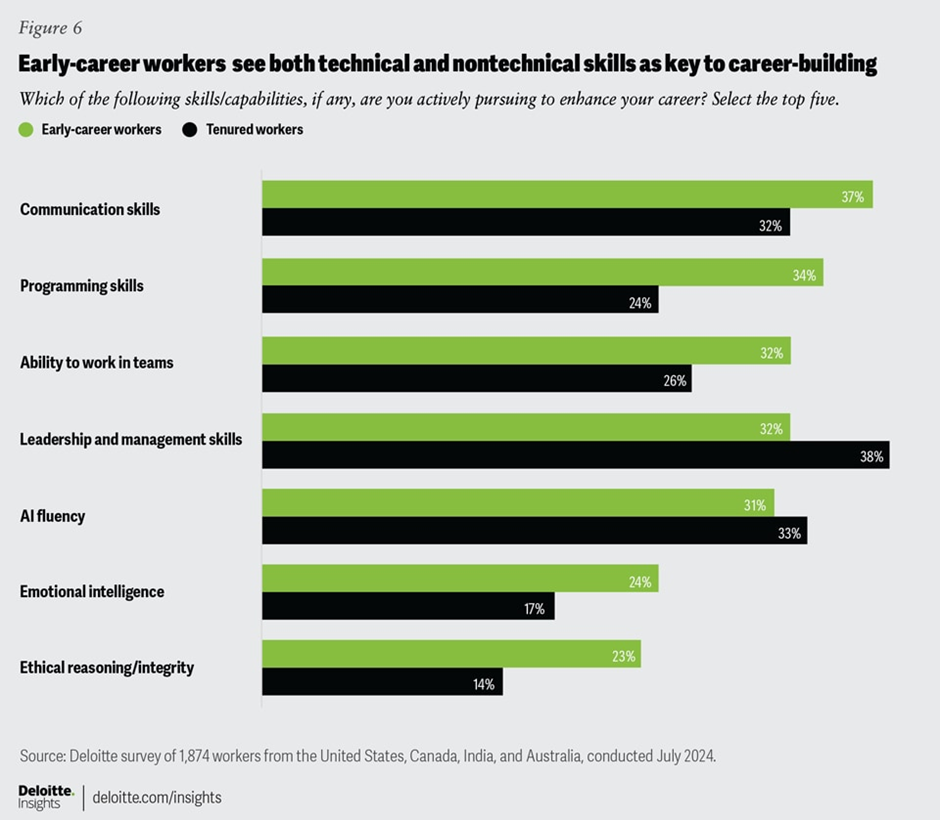
Gen Z’s strengths, however, position them well for this transformation. Their digital fluency, willingness to freelance gigs or portfolio work, and comfort with rapid technology change open new opportunities. Many are exploring roles in emerging areas such as AI ethics, prompt engineering, content moderation, and data management—fields that reward both technical savvy and “uniquely human” skills like creativity, emotional intelligence, negotiation, and ethics.
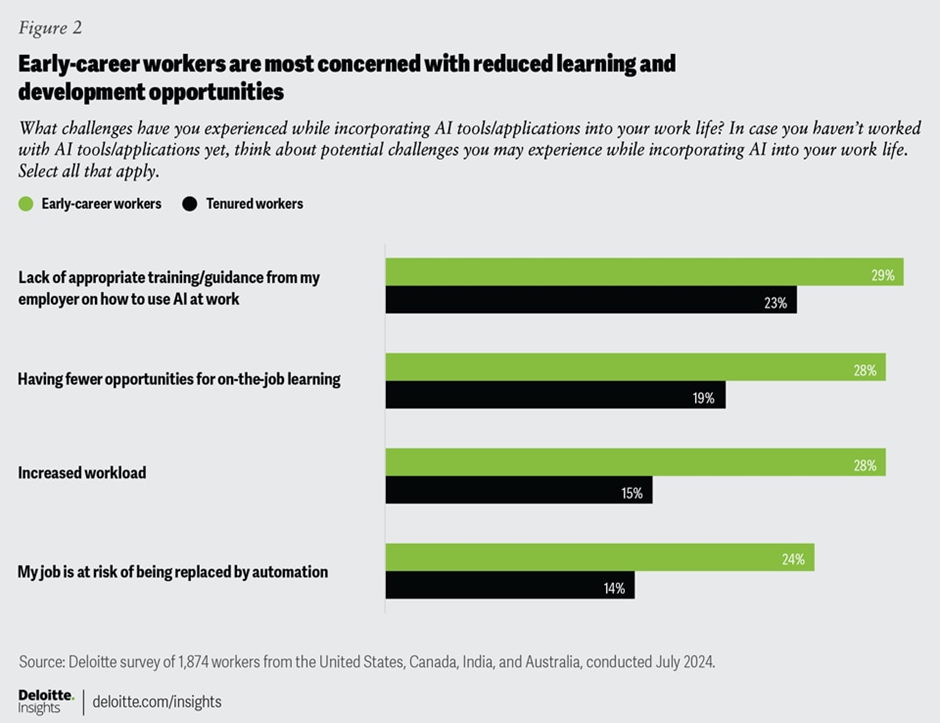
According to a Deloitte study, early-career workers today are often more excited and optimistic about AI’s potential than their more experienced counterparts, likely because they are digitally native and comfortable using these tools. However, many AI technologies are now automating the very tasks traditionally assigned to entry-level professionals. This trend could result in fewer job openings and reduced opportunities for hands-on learning—both essential for long-term career progression.
While traditional roles may be in decline, young graduates who are trained from day one to work alongside AI tools, and who possess new-age skills such as prompt engineering, are better positioned for employment in the evolving job market.
Role of universities and enterprises
To support this critical shift, universities, large organizations, and educational institutions must take a proactive role. The future of employability will depend not only on technical skills but also on adaptability, digital fluency, and uniquely human capabilities such as critical thinking, ethics, collaboration, and creativity—areas where humans continue to outperform machines.
Curricula need to be reimagined to integrate AI literacy across disciplines, encourage interdisciplinary learning, and provide hands-on experience with real-world AI tools. Similarly, career services and internship programs must evolve rapidly to keep pace with technological change, ensuring students gain relevant experience in emerging fields.
Failure to prepare the new workforce in a timely manner risks leaving a generation ill-equipped to compete or collaborate effectively with AI technologies. This could lead to rising unemployment, widened skill gaps, and a workforce struggling to adapt—ultimately hampering economic growth and innovation.
In short, the path forward lies in redefining what it means to be “job-ready” in the age of AI and ensuring educational ecosystems are fully equipped to meet this challenge head-on. With the right training and support, the next generation can not only survive but thrive in an AI-augmented world.