


Google and traditional search engines are being overtaken by GenAI tools like ChatGPT and Perplexity. What comes next?
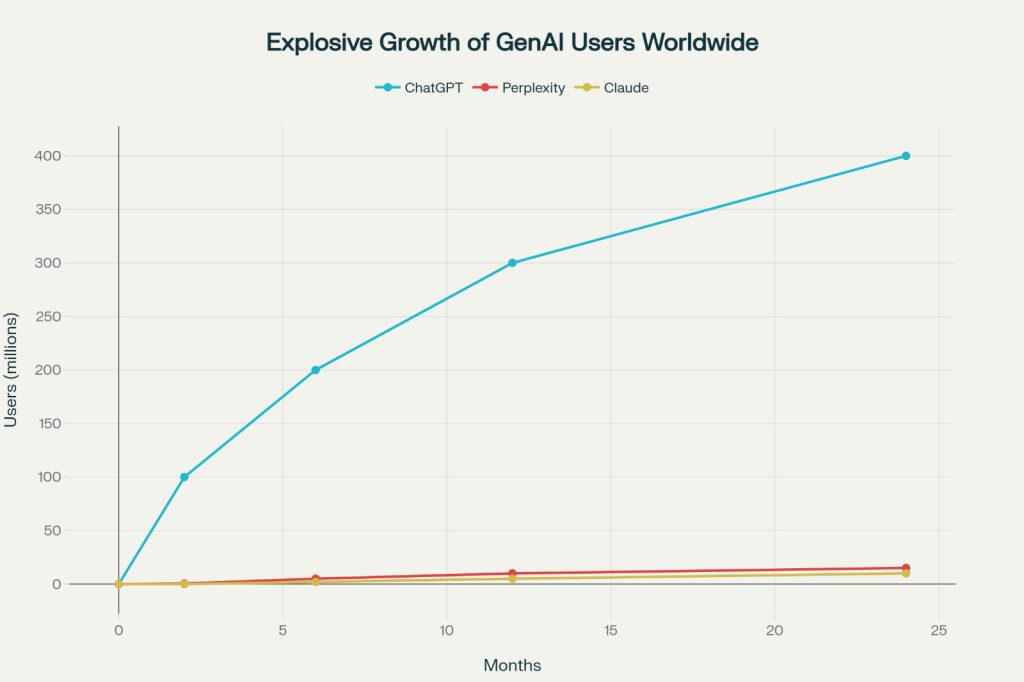
Three years ago, when San Francisco–based OpenAI launched ChatGPT in November 2022, few anticipated the scale at which it would reshape the future of search and information access. Within just two months, ChatGPT became the fastest-growing consumer application in history, surpassing 100 million users by January 2023—a milestone that took TikTok nine months and Instagram more than two years.
Since then, ChatGPT has not only become the most widely adopted AI tool globally but also democratized access to advanced AI, sparking unprecedented interest across industries, education, research, and everyday digital interactions. In less than three years, it has moved from being a novelty to a mainstay platform, fundamentally changing how people learn, work, and increasingly, how they search for knowledge.
The Rise of Generative AI Search
Search used to be about typing keywords into Google and scanning through links. Today, users expect direct answers, summaries, and context—something traditional search engines were never designed to deliver seamlessly. Generative AI (GenAI) tools like ChatGPT, Perplexity, Claude (Anthropic), Gemini (Google), and Microsoft Copilot now provide conversational, contextualized, and often more personalized responses.
The numbers underline this shift:
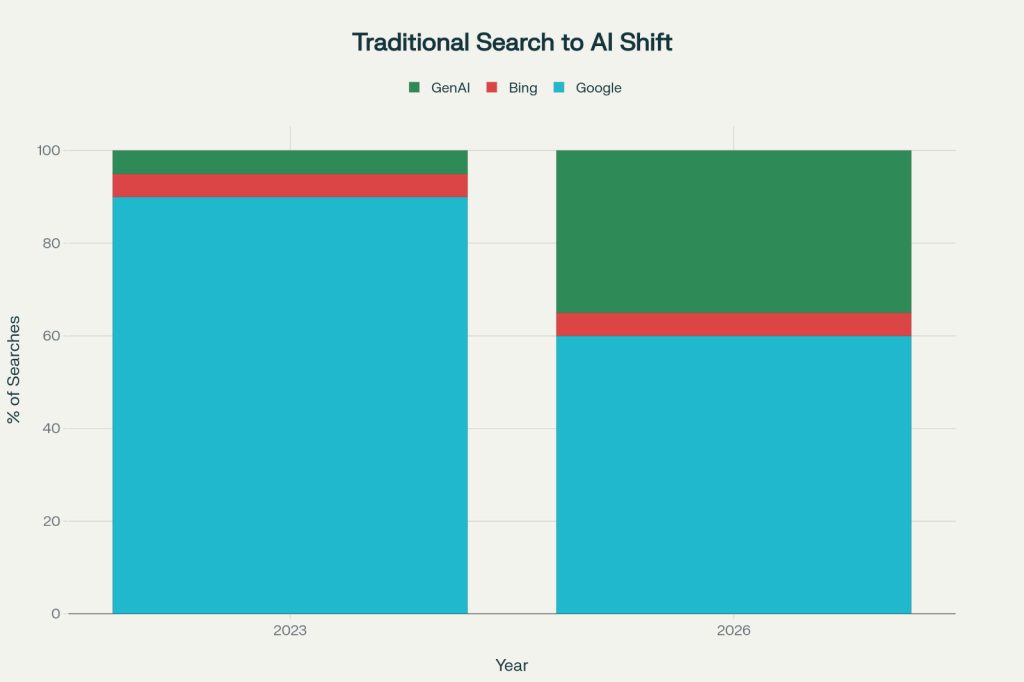
- A 2024 Gartner report predicted that by 2026, 30% of all searches will be done without a traditional search engine, relying instead on AI-driven assistants.
- According to Similarweb, Perplexity AI’s web traffic grew more than 400% in the first half of 2024, making it one of the fastest-growing AI-native search engines.
- Microsoft has integrated Copilot into Windows and Bing, betting heavily on AI-driven discovery to revive its search market share, which has hovered around 3%.
- Google, facing its most serious threat since its inception, has accelerated development of its Gemini AI models, embedding them into both search and productivity tools to defend its dominance.
This competitive landscape feels reminiscent of India’s telecom battle in the 2000s, when dozens of players fought fiercely for mobile subscribers before the market consolidated around a few dominant players. In AI search, too, consolidation seems inevitable.
What Comes Next?
The future of search is likely to be hybrid, multimodal, and highly personalized. A few possibilities stand out:
- Answer Engines Replace Search Engines
Instead of ten blue links, users will receive synthesized, citation-backed answers that combine the knowledge of multiple sources. This is already visible in Perplexity’s “answer-first” approach. - Trust and Accuracy as Differentiators
One of the biggest criticisms of GenAI is hallucination—plausible but false information. The winners of this new search era will be those who can guarantee factual reliability, transparent sourcing, and reduced bias. - Personalized Search at Scale
With access to personal context (work documents, emails, preferences), AI assistants will deliver not just generic answers but personalized insights. Imagine searching for “best CRM” and the AI already knowing your company size, existing tools, and budget. - Integration into Everyday Ecosystems
The boundary between search, productivity, and social tools will blur. Already, AI is being embedded into apps like WhatsApp, Outlook, and Google Docs. The “search box” of the future may not be on a browser—it may be a voice prompt in your smart glasses or a query spoken to your car assistant. - Regulation and Responsible AI
As search becomes mediated by algorithms that decide what information is prioritized, governments and regulators are already stepping in. The EU AI Act and emerging AI regulations in India, the US, and elsewhere will shape how AI-powered search evolves.
Outlook: A New Information Economy
Just as mobile transformed communication and the internet transformed commerce, GenAI is transforming how humans access and value knowledge. The traditional advertising-driven model of search (dominated by Google) is under strain—if AI summarizes information directly, where do ads fit?
Publishers are also caught in the shift. Traffic that once came from Google Search may increasingly bypass them, raising questions about sustainability of content ecosystems. Deals between AI companies and publishers (such as OpenAI’s partnerships with news outlets) are early signs of a new information economy, where knowledge providers are compensated differently.
The battle for the future of search is far from over. But one thing is certain: the age of keyword search is giving way to the age of conversational discovery, where AI not only finds information but also explains, contextualizes, and adapts it to each user.
Like the telecom wars, many players may enter, but only a handful will emerge as the long-term leaders. For users, however, the change promises a more intuitive, democratized, and intelligent way to access the world’s knowledge.