



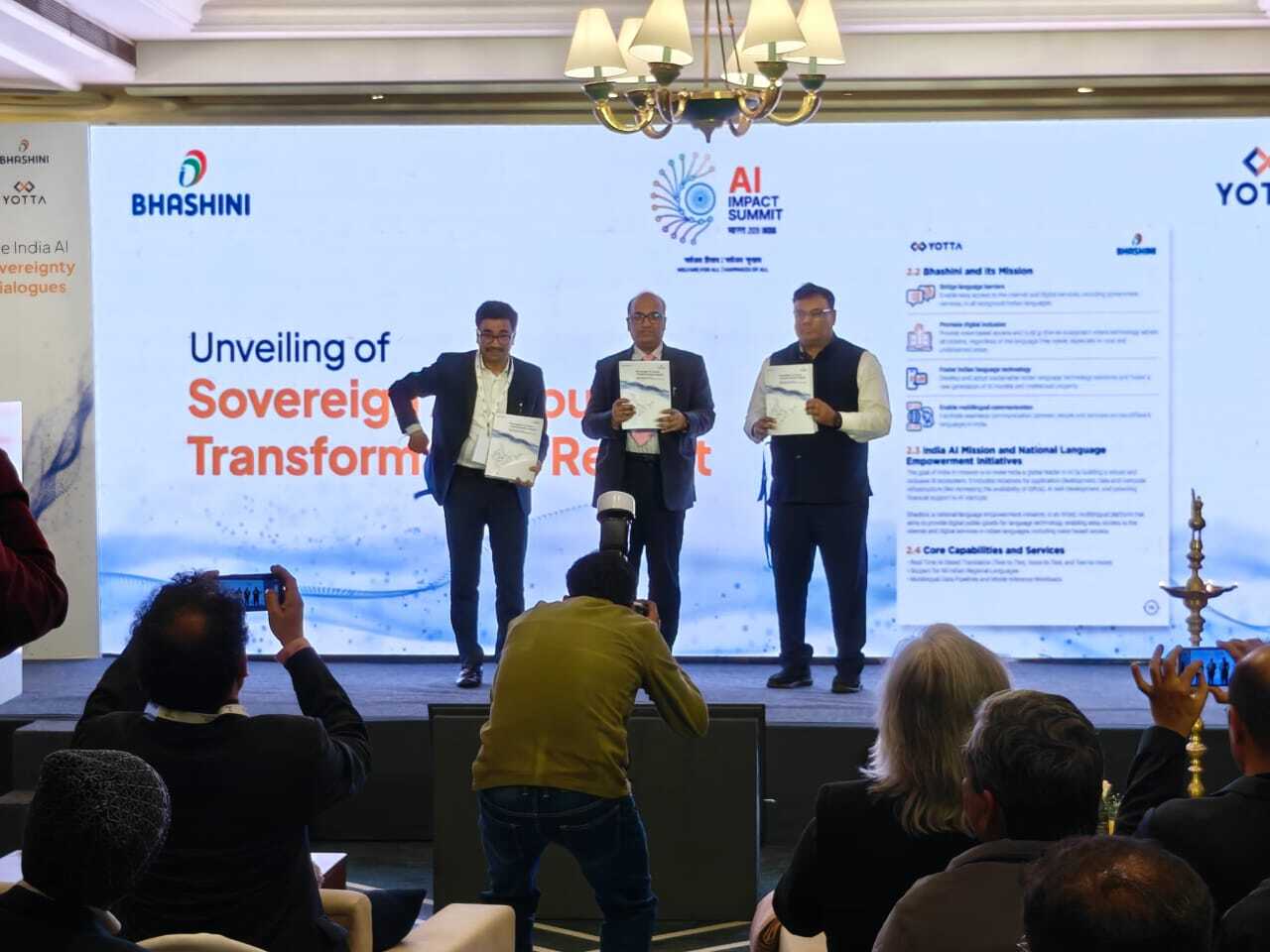
Yotta Data Services has deployed the government-backed BHASHINI language AI platform on its sovereign cloud and GPU infrastructure, marking a high-profile shift from global hyperscaler infrastructure to an Indian-operated AI cloud stack and positioning the move as a reference model for population-scale sovereign AI deployments.
The deployment places BHASHINI, India’s national language AI platform, fully on Yotta’s Government Community Cloud and Shakti Cloud GPU infrastructure. The companies said the transition aligns with the IndiaAI Mission’s push to build domestic compute capacity and sovereign AI platforms, ensuring that language datasets, models and citizen interaction data remain within Indian jurisdiction.
The migration and operating model were showcased at the India AI Sovereignty Dialogues, a pre-summit event ahead of the AI Impact Summit 2026. A related Sovereign AI Cloud Transformation Report outlines the architecture and operational lessons from the transition, positioning it as a reusable blueprint for other public sector and regulated workloads.
BHASHINI, developed under the Digital India programme, provides multilingual AI capabilities including translation, speech and voice services across Indian languages. The platform was tested at scale during the Maha Kumbh 2025 gathering, where it supported real-time translation and voice-based assistance in more than 11 Indian languages through a multilingual assistant branded Kumbh Sah’AI’yak. According to the deployment details, the workloads ran on NVIDIA H100-enabled Shakti Cloud infrastructure.
Government officials framed the migration as proof that large, mission-critical AI systems can be operated on domestic infrastructure without performance trade-offs.
“The successful migration of Bhashini to indigenous cloud and GPU platforms demonstrates that India can build, scale, and secure its sovereign AI systems for the public good,” said Abhishek Singh, Additional Secretary at the Ministry of Electronics and Information Technology and CEO of the IndiaAI Mission. “It underscores the IndiaAI Mission’s vision of developing sovereign compute capacity, models and deploying AI applications that are responsive to India’s unique requirements, including the delivery of reliable, real-time, voice-based services at population scale.”
According to the companies, the migration was completed in two to three months and covered BHASHINI’s full AI stack, including datasets, models, APIs, containerised services, orchestration pipelines, databases and storage layers. The transition reportedly involved more than 200 TiB of data and over 3.5 billion files, with zero data loss.
Performance and cost metrics released with the announcement claim up to 40 percent performance improvement, 20–30 percent cost savings, and 99.99 percent uptime after the move to sovereign infrastructure, though detailed benchmarking methodology was not disclosed.
“The move to Yotta’s sovereign AI cloud gives BHASHINI greater control, resilience, and scalability as it continues to serve India’s linguistic diversity,” said Amitabh Nag, CEO of the Digital India BHASHINI Division. “This transformation strengthens our ability to deliver inclusive, real-time multilingual services and marks a major step forward for Digital Public Infrastructure in AI. It will also serve as a blueprint for future deployments as we transition to a fully sovereign stack.”
From an infrastructure policy perspective, the project is being positioned as more than a platform migration — instead, as a reference architecture for sovereign AI clouds across ministries and public sector agencies. The stack uses open-source, cloud-agnostic components, with an emphasis on vendor neutrality and interoperability, reflecting a broader policy push to avoid long-term lock-in to foreign hyperscaler platforms for critical AI systems.
IndiaAI Mission executives linked the deployment to a wider sovereign compute strategy.
“BHASHINI’s transition to a fully sovereign AI cloud is a significant milestone in IndiaAI Mission’s effort to build population-scale AI on Indian infrastructure,” said Kavita Bhatia, COO, IndiaAI Mission. “This deployment sets a strong blueprint for future public sector AI initiatives.”
For Yotta, the project strengthens its positioning as a sovereign AI and GPU cloud provider at a time when demand for domestic AI infrastructure is rising across government, financial services and regulated sectors.
“Yotta’s successful deployment of BHASHINI on Shakti cloud marks a defining moment for India’s data sovereignty journey,” said Sunil Gupta, Co-Founder, Managing Director and CEO, Yotta Data Services. “This transition highlights that hyperscale, mission-critical AI platforms can be built and operated entirely on sovereign infrastructure, without compromise.”
The collaboration signals a broader shift in how governments are evaluating AI infrastructure — from pure scale and price metrics toward jurisdictional control, auditability, and sovereign operation — especially for population-scale digital public platforms.